Belonging and mutual support in an elderly community
The Thursday Murder ClubBelonging and mutual support in an elderly community are not merely a comforting backdrop at Coopers Chase: they are habits, shared spaces, and practical acts that allow residents to rely on one another. The community’s history reaches back to a convent organized around service, while its present-day residents make connection through weekly meetings, small kindnesses, and a striking collective stand to protect the cemetery. Their solidarity offers companionship and agency, even as grief, illness, and the feeling of being overlooked remain part of life there.
A place shaped by care
The old convent remains at the heart of Coopers Chase, with residential developments arranged around it. For more than a century, the Sisters of the Holy Church had lived together there. The convent’s routines included shared dormitories and meals, prayer, work, and service; its community promised to feed and clothe its members and to continue needing and valuing them. The adjoining Garden of Eternal Rest held the graves of generations of sisters. In this history, belonging is both daily and lifelong: a person has a place among others in life and is remembered among them after death.
The site has since become a retirement community, and the convent has changed with it. Its western side is now glazed to accommodate a swimming-pool complex, a visible contrast with the quiet religious building described in its earlier history. Yet the old grounds still matter to the residents. The Garden of Eternal Rest is not simply land awaiting a new use; its graves connect the living community to people who came before them. That connection helps explain why a plan to disturb the cemetery becomes a question of shared identity as well as development.
Meetings, knowledge, and dependable company
The Thursday Murder Club gives companionship a regular form. Elizabeth Meadowcroft and Penny Gray met every Thursday in the Jigsaw Room, using a booking under the name Japanese Opera – A Discussion to keep their two-hour slot undisturbed. What began as a shared interest in unsolved cases was also social: the two women went through police files together and enjoyed the combination of conversation and mystery. Their meetings made a private room into a dependable gathering place.
The club’s support extended beyond its original members. Ibrahim Arif, a psychiatrist who had played bridge with Penny Gray, helped Elizabeth Meadowcroft and Penny Gray with their inquiries before joining them. Ron Ritchie, suspicious of the group’s cover booking, invited himself into a meeting and was given a file to examine. Elizabeth Meadowcroft recognized that his distrust of what people said could be useful to their work. The club also drew on people with varied expertise, including forensic officers, accountants, judges, tree surgeons, horse-breeders, and glass-blowers, whom Elizabeth Meadowcroft and Penny Gray invited for informal conversations when their knowledge might help.
That informal network sometimes connected with the police. Joyce Meadowcroft recorded that Elizabeth Meadowcroft gave a case file to DCI Chris Hudson and Donna De Freitas, while joking about the group’s need for plausible deniability. In another moment of coordination, Elizabeth Meadowcroft checked the time during an interview and said that Ron Ritchie and Ibrahim Arif should be taking care of something. The episode does not make the club’s methods wholly official; instead, it shows how friendship, local knowledge, and trusted contacts allow the residents to take an active part in matters that concern them.
The cemetery blockade
When the excavation vehicles arrived, news moved through Coopers Chase faster than the machinery. A call about the diggers was recorded at 6:21 a.m.; by 6:45, residents had heard through landlines and were coming out to discuss what to do. The episode gives the community a practical communication system built from familiar connections rather than a digital group that had failed to catch on. By 7:30, residents had gathered as Ian Ventham returned to find the village out in force.
Ron Ritchie turned the gathering into a public objection to the work. He addressed the crowd at the gate and challenged the arrival of the diggers, while Ian Ventham argued that the residents had already pursued their objections through the courts and that the project would help keep their service charges reasonable. The exchange exposed different stakes: the cemetery mattered to the residents as a place of memory, while the development was also presented as a financial benefit. The crowd did not simply disperse after hearing that argument.
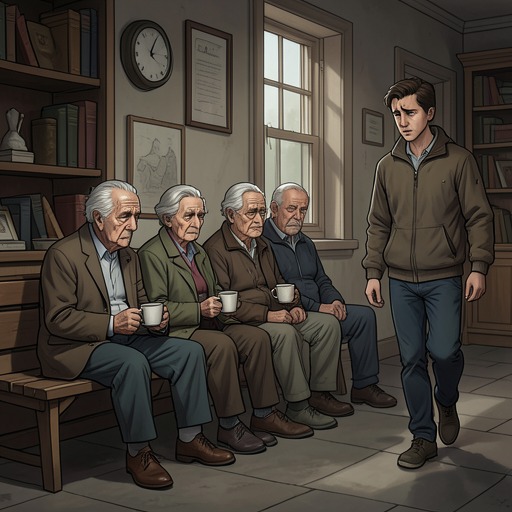
Joyce Meadowcroft and Bernard Cottle returned carrying garden chairs and opened them on the path. Joyce Meadowcroft invited people to make a day of it; Ron Ritchie turned the suggestion into a call for a sit-down and tea. Soon twenty chairs, mostly sun loungers and including a dining chair chosen with Miriam’s back in mind, blocked the narrow route to the Garden of Eternal Rest. Some residents rested in the morning sun, but the arrangement also prevented the diggers from passing. The blockade makes mutual support concrete: residents gave one another company and turned that company into a barrier.
Even within this gathering, the possibility of loss shaped relationships. Seeing John, Penny Gray’s husband, on his way to Willows, Ron Ritchie felt guilty that he had not visited Penny Gray for a long time. He knew he ought to put that right, but the prospect frightened him. The scene places an unfulfilled act of care beside the residents’ collective action: community can bring people together, but it does not automatically resolve the difficulty of approaching illness and impending loss.
Everyday kindness and uneven inclusion
Joyce Meadowcroft’s account of falling on a Fairhaven pavement shows mutual aid outside the circle of Coopers Chase. After she tripped and dropped her belongings, a cyclist helped her stand, a traffic warden gathered her things, a woman with a pushchair sat with her, and the café owner brought tea and offered to drive her to a doctor. Joyce Meadowcroft wondered whether they had helped because she looked old and frail, but concluded that they would have helped a younger person too. Her reflection treats kindness not as a special privilege of old age but as an ordinary obligation people may offer one another.
Care also appears in intimate relationships shaped by cognitive decline. Elizabeth Meadowcroft and Stephen discussed his supposed daughter Emily: Stephen worried that she was too thin and did not visit often enough, and Elizabeth Meadowcroft agreed to speak with her. The scene then clarifies that Emily was Stephen’s first wife, who had died nearly twenty-five years earlier, and that Stephen had no children. Elizabeth Meadowcroft’s willingness to respond belongs to the practical work of living alongside a partner whose memory is changing; the tenderness of the exchange coexists with the painful gap between what Stephen believes and what is true.
The boundaries of belonging are visible too. While digging in the Garden of Eternal Rest, Bogdan Jankowski thought about Marina, whom he had encountered in the village. He felt that people mainly did not talk to him or notice him, and wondered whether he might one day see her again. He also missed his mother. This moment does not show the community reaching out to him; rather, it registers the loneliness that can persist alongside the residents’ solidarity. The contrast prevents mutual support from becoming a claim that everyone is equally connected.
Companionship, grief, and a chosen place
Ibrahim Arif understands Coopers Chase as a lively community, full of committees, arguments, gossip, new arrivals, and farewells. Its doors offer a simple form of choice: a resident can close one to be alone and open it to join others. That balance matters especially for Bernard Cottle, whose wife has died and whose grief has not lifted. Ibrahim Arif and Ron Ritchie do not treat Bernard Cottle’s wish to sit alone on Fairhaven Pier or on a hilltop bench as something that needs explaining or correcting. Their account of community allows solitude to be respected as well as company to be offered.
Ron Ritchie’s sense of belonging has itself changed. When Ibrahim Arif asks where he finds peace, Ron Ritchie recalls that he might once have laughed at the question and left. Instead, he recognizes the comfort of sitting in a chair with his friend, sharing whisky in the dark and having something to talk about. He thinks of the people who did not survive and of the unlikely fact that he and Ibrahim Arif, a boy from Kent and a boy from Egypt, made it through. His answer locates peace not in escape from history but in present companionship.
Across these scenes, Coopers Chase is more than a collection of homes or a place with an appealing history. Its residents make belonging through repetition—Thursday meetings, familiar conversations, and the option of an open door—and through response when another person needs help. Their care can be organized, as in the cemetery blockade, or as small as picking up a stranger’s belongings. It cannot abolish bereavement, cognitive decline, or loneliness, but it gives those experiences a social setting in which people may be noticed, remembered, and accompanied.